
Incredibly, after a nearly four-year run, Jersey Boys Australia
will take its final bow in about two weeks. One of the world's most
successful musicals in decades has certainly been a hit Down Under, as
it has around the world. And for me, this will mark the third time I
will be saying "Bye Bye, Baby" to the show. Will it be for good this time?
Who knows.
Facing another closing night has inspired me to look back and
examine my time with this show. And because I think you might find it
interesting, I've decided to share some of these thoughts with you.
Specifically, my goal is to put into words exactly what it's like to be
an actor playing this iconic person in this famous band in this amazing
show, six nights a week.
Part 3 of an on-going series of Top 5’s that illuminate what it’s like
to play Frankie Valli in the long-running show, Jersey Boys. Parts 1 and 2 are linked below, or you can also find them to the right, by clicking on 2013, then clicking on May.
http://jeffmadden.blogspot.com.au/2013/05/jb-top-5s-5-moments-that-make-my-heart.html
http://jeffmadden.blogspot.com.au/2013/05/jersey-boys-top-5s-5-moments-that-make.html

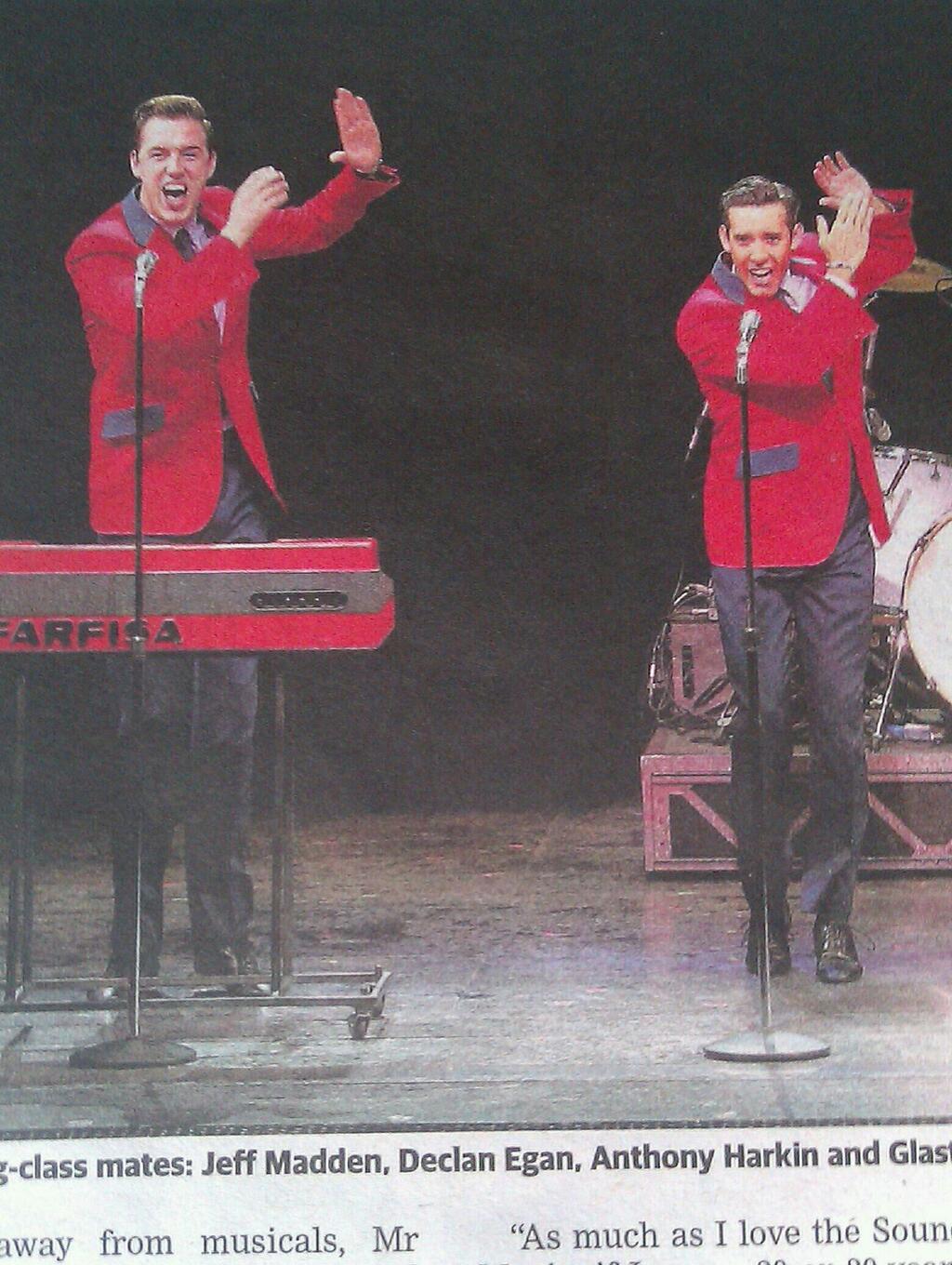
From L-R: Declan Egan (Bob Gaudio), Me, Anthony Harkin (Tommy DeVito), Glaston Toft (Nick Massi)
*************************************************************************************************************************************************************
Today's Subject: The Top 5 Daily Must-Dos
“It must be so glamorous getting to play Frankie Valli! You
must be having so much fun up there - You make it look so easy onstage! It must
be nice, only having to work at night!” These are a few of the typical comments
I hear from audience members after the show at the stage door. I also get, “How
do you do that – is that your normal
singing voice?” And then, “Oh, you have an accent - What part of the States are
you from?”
My answers are usually – “Glamorous - not really. Fun –
absolutely! Easy – not on your life!” Basically, most of the time, an actor’s life is not
what you might think. It’s a tonne of hard work, we’re just trained to make it
look easy. Now, trying to answer the question about my ‘normal’ voice and how I
sing like Frankie… well, that’s hard work, too. It’s actually a fascinating
question, one that I will address throughout this Top 5 post. (Oh, and I answer
the ‘Where in the States’ question with “The Canadian part.”)
It’s pretty obvious that playing ‘Frankie Valli’ in Jersey Boys is kinda difficult. There’s
the singing technique, power and endurance required, in addition to closely approximating
Frankie’s iconic sound. Then there’s the acting skill required to play this world-famous
Italian-American from a dirt-poor teenager to a Rock and Roll legend. There’s more
than a few dance skills required, not to mention the fitness to sing and dance
through 25 songs and all those scenes with only a few very short breaks.
But on top of all that, in order to succeed in this role,
you’ve got to be reliable. You’ve got to have the endurance to deliver the
goods night after night, six days a week. And in my opinion, maintaining this
endurance is the hardest part of doing this role. It’s also probably the
trickiest to predict in an individual, from a casting point of view.
For me, being reliable has been
a point of pride throughout my whole life. Whether at school, or the baseball
field, as a band member – heck, just as a person – I've always tried to make it a part of my character.
But, how does an actor do ‘reliable’? I think it starts with really knowing yourself. Throughout my 16 years being a professional actor
and singer, I’ve been undergoing a never-ending exercise in self-awareness. I constantly “check in with myself”, during rehearsals,
during warm-ups, during performances (if the occasion permits), and after the show. It’s
a process that every actor needs to develop in order to get better in their
craft.
For example, I’m constantly checking in with my muscles –
vocal and otherwise - to see how they felt after doing a particular section of the show. I’ll ask myself, “How did that section
go – great or less than great? And how did it feel? Did I do something
differently there? And if the answer is yes, was the outcome the same, better,
or worse? If it was better, is it worth making the change permanent?” On my
breaks, I’ll write down the information gathered from doing this type of
analysis into a notebook which I keep in my dressing room. I’ll refer to the
notes on a constant basis until the information becomes a part of my muscle
memory. Sometimes, if I’ve gotten into some bad habits, I’ll look back through
my notebooks and invariably come across the solution.
When doing a challenging show six days a week, I’ve found
that the most important factor for being reliable is being properly warmed-up. Obviously,
how you warm up depends on the role you’re playing. For some shows I’ve been
in, warming up is a 20-minute thing. You stretch for a minute or two, you
vocalize for maybe 10 minutes, maybe have a cuppa joe, and throw on your
costume. Other roles have been much harder. For example, playing Homer in Floyd Collins at the Shaw Festival back
in 2004 was so vocally and physically challenging for me that I was having
problems consistently being my best. I discovered that by spreading out my warm-up
into shorter intervals throughout the day - thus gently nudging my voice and
body in the direction that they needed to go - I would have a better show than
if I just warmed up during the hour before curtain. That experience helped
prepare me for this one.
Doing Frankie consistently well requires the most intensive
warm-up I’ve ever had to do. I’ve developed it from listening to my creative
team - who’ve learned from other Frankie’s experiences - and from doing this
type of self-awareness analysis from Day 1. If I waver from it, injuries inevitably start
to creep in. They’re usually minor at first, but they can quickly escalate to
major issues. And trust me, you don’t want to be doing this role in pain – talk
about a nightmare. (My experiences there might soon be the topic of another Top
5 list…)
So, without further ado, here are the Top 5 things that I must do
every day to be my best onstage as Frankie Valli every night. (I don’t know what the other
Frankie’s past and present do to get ready to play this part every day. It may
be very similar, it may be completely different. This post is only meant to
describe what it’s like for me personally.)
·
1. Get eight hours of sleep, eat healthily, take
vitamins, and drink tons of water.
Sleep is a no-brainer. Your body repairs itself while you
sleep, leaves you with enough energy, and keeps your mind sharp. ‘Nuff said.
Like anyone who wants to perform at their highest level,
musical theatre performers must eat a healthy diet and supplement with vitamins
as required. I’ve always had a high metabolism, so I’m usually quite hungry in
the morning. I never skip breakfast. Ever. I’ll try to have a large healthy lunch,
but sometimes the lunch is small and the dinner is large. But whatever I do –
and I’ve learned this the hard way – I never perform Jersey Boys with food in my system. Ideally, the last meal I eat
will be between two and three hours before showtime. There’s way too much
running around while vigorously using my diaphragm singing and screaming in
this show to have food in my system. Ugh… I’m getting sick just thinking about
it.
And water. I never stop drinking water during the day. It
keeps the voice happy, heals up everything quickly, and keeps things running smoothly.
I probably drink 2-3L of water during the day, then another 2L at the theatre
between warm-up and warm-down. Maybe more. (And yes, I have planned my drinking
and bathroom breaks very carefully during the show… haha).
·
2. Minimum 20-minutes of a tongue-pulling vocal
warm-up.
What? Tongue-pulling? Yup. Singing rock music for a couple
hours puts a huge strain on the tongue muscle, not to mention many other
muscles in the face, neck, chest and back. Everyone knows that it’s extremely
beneficial before and after exercise to stretch your muscles to avoid muscle
pain, cramping and inflammation. The tongue is no different, and gently pulling
it forward while doing a series of vocal exercises has proven time and time
again to keep the vocal apparatus healthy enough to rock it out six days a
week.
This lesson was first drilled into me in a recording studio
in Nashville, TN where I met the one and only Bob Gaudio and the woman who
would become my new best friend, vocal teacher Katie Agresta. Katie teaches her
methods to all the Frankie’s around the world, whether in-person or by Skype,
and I know that utilizing Katie’s knowledge has greatly helped my reliability.
If you’re reading this, “Thanks for everything, Katie!” (Incidentally, she has
taught, among others, Jon Bon Jovi, Lenny Kravitz, and recent Tony-award winner
Cindy Lauper… so, Katie’s kind of a big deal…) Also, “Thank you, Dodger Theatricals,
for contracting Katie to teach all your Frankie’s – smart move!” It’s sure made
a difference in my career.
I do tongue-pulling vocal exercises for at least 20-minutes
before the show, and for about 15-minutes after the show as part of a
warm-down. Every single show, without fail. It works.
·
3. Minimum 20-minutes of a “legit” Bel Canto
vocal warm-up.
Bel Canto is Italian for “beautiful singing”, but I’m referring
here to the Bel Canto teaching style for singers. It is widely used to train
singers in a ‘classical’ or ‘legitimate’ style of sound production that dates
back to the late 1700s. I was taught this technique for about seven years while
working at the Shaw Festival by the inimitable Carol Forte (and if that isn’t a
great singing teacher’s last name, I don’t know what is).
Singing with this technique is considered the ‘healthiest’
style of singing, and when done correctly, it produces a beautiful tone while
putting the least strain on the voice. My friend Wikipedia tells me that when
using this technique properly, singers will have an impeccable legato
production throughout a seamless range and the use of a lighter
tone in the higher registers, giving the
singer an agile, flexible voice capable of dispatching ornate embellishments
(um, licks?), the ability to execute fast, accurate divisions (um, runs?), the
avoidance of aspirates (wuh?), a pleasing timbre (“look out below!”) and a
graceful phrasing rooted in a complete
mastery of breath control.
Basically, it helps me sing good! If I don’t warm-up with
Bel Canto exercises for a few days, my tone suffers and I lose the ease of
connection through the bridge (between my chest voice and falsetto) which, in
this show, is deadly. That’s why I do them. I remind my voice what’s healthy
before I go out and shred it. (“Thank you, Carol! You Rock – but in a
legitimately healthy way!”)

·
4. Minimum 20-minutes of a “mixed” head-voice
dominant vocal warm-up.
I usually do these exercises during the last 45-minutes just before the
show every day, and helps me to solidify that iconic “Frankie” sound. Here, I
combine specific exercises from my work with Katie with specific exercises from
my work with Carol, and add in what I learned from Bob Gaudio in that Nashville
studio. I throw all of that into a blender, add in some tobacco sauce and some roasted
garlic, say a couple prayers, and Viola- I’m ready to go.
It’s really quite difficult to describe, but there are a few
particular exercises that help me merge my chest voice with my falsetto in a silky
smooth manner. When done properly, this allows me to sound a lot like Frankie
while still singing in a healthy, Jeffy-like way (Or, is that J-e-f-f-i?). Regardless,
this step is also essential for helping me make believers out of the audience.
·
5. Minimum 30-minutes of a physical warm-up.
So, again, this kinda goes without saying, but if you want
to do a physical activity well, you’ve got to warm-up your muscles. And playing
‘Frankie Valli’ certainly qualifies as physical activity. I’ve never been a
good runner – for me, running creates more problems than it helps – so I like
to ride a bike for a light cardio warm-up. Failing that, I do lots of squats, lunges
and step-ups. Singers need to warm their legs, their glutes, their back and
their core, because despite what you might think, all of those muscles are
essential to proper singing and voice production.
I have found that Yoga is also extremely helpful for me, and
I do about three 30-minute sessions a week now (I used to do 30-minutes every
day in my early days playing Frankie back in Toronto in 2008). I had never done
Yoga before starting Jersey Boys, but
my good friend and assistant choreographer Danny Austin told me to start doing
it during our first conversation after I got the job. “Thanks, Danny! You’ve
helped me more than you could possibly know!” (Oh, and those Side-Splits would
have never happened without it!)
I also lift weights in a circuit, once or twice a week,
hitting all the muscle groups. I try not to get into the same pattern of
exercises, because I find the body adapts very quickly to them, lessening their
effect. I don’t lift heavy weights at all, because doing so definitely affects
my performance – trust me, dragging lead-like lactic acid-filled muscles around
the stage at a high pace for two hours is a nightmare. And of course, before
show-time, I like to make sure I get a nice stretch through my hips, my
rib-cage, my chest, shoulders and neck. I gently repeat these stretches after
the show as part of my 15-minute warm-down before heading out of the theatre.
It’s all part of the daily routine of being a Frankie. A
‘good ol’ reliable’ one, as the famous song from Guys and Dolls goes. (By the
way, I can’t wait to see that show down at the Shaw Festival in Niagara this summer – I
hear it’s a wonderful production. Go see it.) Till next time.
